
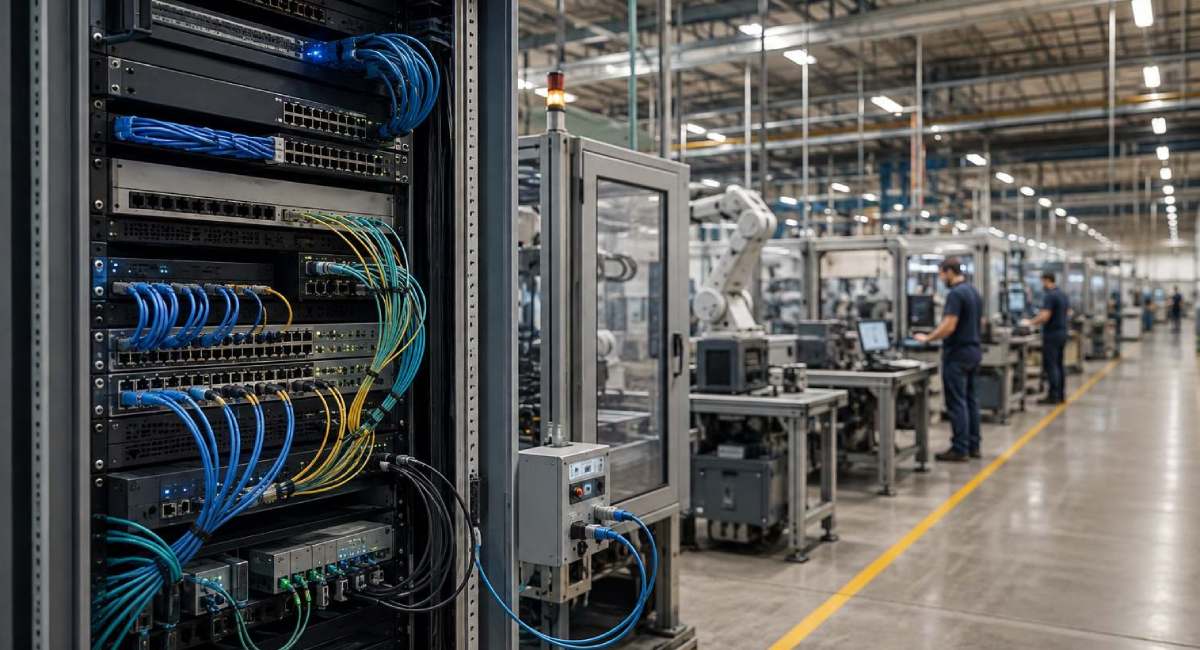
For most manufacturers, network infrastructure isn’t something anyone thinks about until it fails. The cabling running behind the walls and through the ceiling of a plant floor rarely gets a line item in the budget until a sensor drops offline mid-shift, an ERP connection times out during a shipment window, or a new piece of automated equipment simply won’t talk to the rest of the network. By then, the cost of “not thinking about it” is already reflected in the production report.
We’ve spent close to three decades installing and testing structured cabling for businesses across Connecticut, and manufacturing clients have become one of the areas where we see the widest gap between what a company’s operations actually need and what its physical network can support. As plants add sensors, cameras, automated equipment, and cloud-connected systems faster than their underlying cabling was ever designed for, that gap tends to grow quietly until something forces the issue.
Here’s what we think growing manufacturers should understand about their network infrastructure before that happens.
The Financial Stakes Are Higher Than Most Teams Assume
Downtime in manufacturing isn’t cheap, and it’s getting more expensive. Industry benchmarking puts the average cost of unplanned downtime at roughly $260,000 per hour per facility, and the average U.S. manufacturer loses somewhere around $39,000 in output for every hour a line sits idle. At the high end, automotive assembly lines can lose more than $2 million an hour when production stops.
Zoom out and the numbers get bigger. A widely cited Siemens analysis found that unplanned downtime now consumes roughly 11% of annual revenue at the world’s 500 largest companies — a combined loss of about $1.4 trillion, up sharply from $864 billion just five years earlier. Plants also aren’t just dealing with rare catastrophic failures: many facilities log 800 or more hours of downtime a year across planned and unplanned events combined, and nearly half of manufacturers who’ve experienced unplanned downtime say it left them unable to deliver on customer commitments.
Not all of that downtime traces back to structured cabling and connectivity, obviously — but a meaningful share of it does, and it’s among the most preventable. A degraded fiber run, an oversubscribed switch, a cabling closet that was never documented properly, or a network that simply wasn’t built to carry the data load of a modern, sensor-heavy plant floor: these are infrastructure problems with infrastructure solutions, not equipment failures that require a capital replacement.
Manufacturing Is Driving Real Growth in Network Investment
This isn’t a niche concern. Manufacturing now accounts for roughly 17% of demand in the global network infrastructure market, and manufacturing and utilities combined make up more than a quarter of all new infrastructure deployments, driven largely by industrial automation, IoT adoption, and edge computing. Nearly 54% of manufacturers are already implementing edge computing specifically to support predictive maintenance and improve operational efficiency — which only works if the underlying network can reliably move sensor and machine data in real time, without bottlenecks.
Predictive maintenance itself is projected to be the largest application segment in the industrial IoT market this year, and it depends entirely on dense, low-latency connectivity across the plant floor — the exact kind of coverage that aging or ad hoc cabling struggles to provide.
The IT/OT Convergence Problem
A few years ago, a plant’s operational technology (the machines, sensors, and control systems on the floor) and its information technology (email, ERP, cloud systems) largely lived on separate networks. That’s changed. As manufacturers connect equipment to cloud dashboards, remote monitoring tools, and AI-driven analytics platforms, those two worlds are merging onto shared infrastructure — and that convergence is becoming one of the biggest points of vulnerability in the industry. Analysts studying industrial networks have flagged IT/OT teams operating independently, without shared visibility into the network, as a direct driver of weaker performance and weaker security.
For a growing manufacturer, this means the cabling and network design decisions made today — how segments are separated, how new equipment gets added, how much headroom exists for the next system — directly affect both uptime and cybersecurity exposure for years to come.
What This Means for Your Cabling and Network Design
A few practical implications for manufacturers that are growing, adding equipment, or simply haven’t had their infrastructure reassessed in a while:
Fiber backbone, not just copper. As plants add cameras, sensors, and bandwidth-heavy automated systems, a fiber backbone between buildings and major equipment areas prevents the bottlenecks that copper-only networks begin to hit as demand grows.
Design for segmentation from day one. Separating OT and IT traffic — rather than bolting security on after the fact — is far easier to do correctly during a cabling installation or upgrade than to retrofit later.
Don’t underestimate PoE demand. Power over Ethernet is increasingly used to run cameras, access points, and sensors without a separate electrical run to each device. Cabling infrastructure designed without PoE capacity in mind becomes a limiting factor fast as smart-plant initiatives expand.
Test, don’t assume. OTDR (Optical Time-Domain Reflectometer) testing verifies that fiber runs are actually performing to spec — not just installed, but installed correctly. On a plant floor where a single degraded run can take down a production line, that verification step isn’t optional.
Plan for scale, not just today’s headcount. A network designed for a 20,000-square-foot facility with basic office connectivity won’t necessarily support that same facility after it adds a robotics cell, a new ERP integration, and a dozen IoT sensors. Growing manufacturers should treat cabling capacity the same way they treat floor space or equipment capacity: something to plan ahead for, not react to.
Why Certified Installation Matters More on a Plant Floor
Manufacturing environments are harder on cabling infrastructure than a typical office. Heat, vibration, electromagnetic interference from heavy equipment, and dust all shorten the effective life of a poorly installed or poorly rated cabling system. That’s part of why manufacturer certifications — like Corning’s Network of Preferred Installer program, which requires installers to meet specific training and quality standards — exist in the first place. An installer who’s certified to a manufacturer’s standards isn’t just familiar with the products; they’re accountable to a documented process, which matters when a failure could mean a six-figure-an-hour production stoppage rather than a slow office Wi-Fi connection.
We’ve completed more than 3,500 cabling and network infrastructure projects across our 28 years in business, maintaining a 99% client satisfaction rate along the way, and manufacturing clients are consistently among the ones where getting the underlying infrastructure right — quietly, correctly, the first time — has the biggest downstream impact on their operations.
Frequently Asked Questions
How do I know if our current cabling can support new automation or IoT equipment?
The most reliable way is a physical infrastructure assessment — testing existing runs (including OTDR testing on fiber), reviewing switch and port capacity, and mapping current bandwidth use against what new equipment will require. Guessing based on age alone isn’t reliable; a five-year-old installation done poorly can be more limiting than a fifteen-year-old one done well.
What’s the difference between copper and fiber for a manufacturing environment, and do we need both?
Most growing facilities end up with both. Copper (typically Cat6 or Cat6A) is usually fine for individual device drops — workstations, access points, cameras — over shorter distances. Fiber is better suited for backbone runs between buildings, floors, or equipment-dense areas, since it carries more bandwidth over longer distances and isn’t affected by the electromagnetic interference common around industrial equipment.
How often should a manufacturing facility have its network infrastructure reassessed?
As a general guideline, any time you’re adding a new production line, a significant number of connected devices, or expanding square footage. Outside of major changes, an infrastructure health check every few years is a reasonable baseline, similar to how you’d schedule maintenance on physical equipment.
Does upgrading network infrastructure require shutting down production?
Not necessarily. Experienced installers can often phase cabling and network work around production schedules, working in unused areas, off-shifts, or planned maintenance windows to minimize disruption. This is worth discussing directly with your installer during the planning phase, since every facility’s constraints are different.
What should we look for when hiring a cabling contractor for a manufacturing facility?
Manufacturer certifications (such as Corning NPI), a track record of completed projects, willingness to perform and document OTDR or equivalent testing rather than just “pulling cable,” and experience specifically in industrial or plant-floor environments rather than office-only installations.
Sources
- Splunk / Cisco, “Hidden Costs of Downtime 2026” report — https://gatling.io/blog/the-cost-of-downtime
- Yahoo Finance / Siemens (2024 report), “What Network Downtime Really Costs Manufacturers” — https://finance.yahoo.com/sectors/technology/articles/network-downtime-really-costs-manufacturers-203738674.html
- IndexBox, “Manufacturing Network Downtime Costs: $1.4 Trillion Loss, $260,000 Per Hour Per Plant in 2026” — https://www.indexbox.io/blog/network-downtime-costs-manufacturers-billions-analysis-of-2024-siemens-report/
- Manufacturing Lead Generation, “Manufacturing Downtime Cost Statistics 2026” — https://manufacturingleadgeneration.com/manufacturing-downtime-statistics/
- Global Growth Insights, “Network Infrastructure Market Growth 2026–2035” — https://www.globalgrowthinsights.com/market-reports/network-infrastructure-market-116404
- Modularis, “5 IoT in Manufacturing Statistics and Trends for 2026” — https://www.modularis.com/modblog/iot-in-manufacturing-statistics-trends/
- Cisco, “State of Industrial AI Report 2026 – Manufacturing” — https://www.cisco.com/site/us/en/solutions/networking/industrial-iot/industrial-networking-report/manufacturing.html
- Corning, Network of Preferred Installer (NPI) Program overview — https://www.corning.com/optical-communications/worldwide/en/home/loyalty-programs/network-of-preferred-installers.html