Running a nonprofit in Connecticut means doing more with less — tighter budgets, leaner staff, and technology decisions that often get pushed to the bottom of the priority list until something breaks. But the technology infrastructure running behind the scenes at your organization directly affects your ability to serve your mission, communicate with donors, and keep your team connected whether they’re in the office or in the field.
Connecticut nonprofits face technology challenges that are different from a typical for-profit business — and the solutions need to reflect that reality. Teleworks has installed and supported technology infrastructure for organizations across Hartford County for decades, including structured cabling, business internet, phone systems, and video conferencing. Here’s what every Connecticut nonprofit should know about its technology infrastructure—and where most organizations fall short.
Why Nonprofit Technology Infrastructure Is Different
Most nonprofits approach technology the same way they approach everything else—find the lowest-cost option that technically works and move on. That mindset is understandable given budget pressure, but it creates problems that compound over time.
Staff and volunteer turnover is high. Every time a key staff member leaves, institutional knowledge about the organization’s technology walks out the door. A network with no documentation, unlabeled cabling, and undocumented phone system configurations becomes a crisis every time someone who knew how it worked moves on.
Donor-facing communication is mission-critical. A donor who calls your organization and reaches a confusing auto-attendant, gets dropped, or waits on hold indefinitely forms an impression that affects their giving decisions. A board member who joins a video call from a conference room with poor audio and a ceiling-mounted camera angle is getting a signal about organizational competence that has nothing to do with your programs.
Grant compliance creates documentation requirements. Many federal and state grants require documentation of how technology resources are used and maintained. An organization with no cable documentation, no network diagram, and no maintenance records is in a difficult position during an audit.
Remote and hybrid work is the new normal. Connecticut nonprofits increasingly have staff working from home, from program sites, and from partner locations. A phone system that only works at a desk and a network that can’t support remote connectivity aren’t just inconvenient — they limit your organization’s ability to attract and retain the staff you need.
The Technology Infrastructure Most Connecticut Nonprofits Actually Have
In our experience working with nonprofits across Hartford, New Haven, and the greater Connecticut area, the gap between what most organizations have and what would actually serve them well is significant. The most common infrastructure problems we find:
- Aging Cat5e cabling installed during an original office setup that was never updated — now struggling to support VoIP phones, video calls, and cloud platforms simultaneously.
- Consumer-grade routers and switches that were purchased because they were cheap and have been running without maintenance for years
- A phone system that was configured by someone who no longer works there and that nobody fully understands
- No guest WiFi separation — donors, volunteers, and visiting partners connect to the same network as staff computers and donor databases.
- No internet redundancy — a single connection with no failover means a carrier outage stops program delivery, donor calls, and staff communication entirely.
- Conference rooms with no proper video conferencing setup — a laptop on the table for board meetings and donor calls
None of these are unusual. All of them are fixable — often at lower cost than most nonprofit administrators expect.
Structured Cabling That Doesn’t Need to Be Replaced Every Five Years
The most common infrastructure mistake Connecticut nonprofits make is choosing the cheapest cabling option during an office setup or renovation — and then paying significantly more to fix it five years later when it can’t keep up with modern demands.
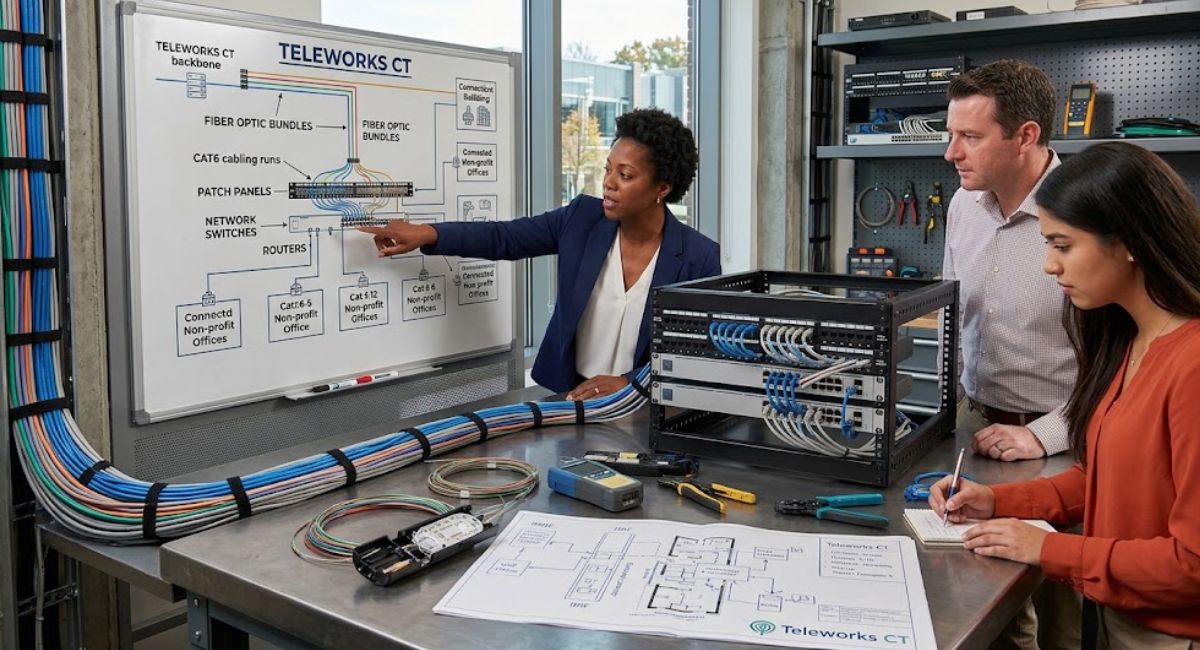
A properly installed structured cabling system for a Connecticut nonprofit includes Cat6 or Cat6A cable throughout, certified testing documentation on every run, labeled cable management that any technician can understand, and enough drops at every workstation and program area to accommodate growth without requiring new cable runs.
The upfront cost difference between a minimum installation and a properly designed one is typically modest. The difference in how long that infrastructure serves the organization without modification is measured in years. For a nonprofit where every dollar needs to go as far as possible, getting cabling right the first time is one of the best infrastructure investments available.
Phone Systems That Work for How Nonprofits Actually Operate
A nonprofit phone system has requirements that a standard business phone system may not address without proper configuration. Staff work from multiple locations. Volunteers answer phones with varying levels of training. Donors call a main number expecting to reach the right person quickly. Board members need to join calls from anywhere.
A modern VoIP phone system configured for a nonprofit environment includes:
- An auto-attendant that routes callers to the right program area or staff member professionally — even during evenings and weekends when staff aren’t in the office
- Mobile app access so staff and key volunteers can make and receive calls on their personal phones using the organization’s number without giving out personal numbers
- Voicemail-to-email so messages reach the right person, whether they’re at their desk.
- Ring groups that distribute donor and program calls across available staff so no call goes unanswered during peak periods
- Call recording for training purposes and documentation of donor conversations where relevant.
Many Connecticut nonprofits are also eligible for discounted technology through programs like TechSoup and nonprofit pricing offered by major technology vendors.¹ The right technology partner helps identify these opportunities before recommending any solution.
Internet Connectivity and Redundancy for Program Delivery
Many Connecticut nonprofits have shifted significant program delivery online — virtual counseling sessions, remote case management, online training, and hybrid board meetings are now standard. An internet connection that goes down during a client session or a board call isn’t just an inconvenience — it’s a program delivery failure.
A business-grade internet connection with redundancy means that when your primary connection goes down, a secondary connection automatically takes over. For a nonprofit serving vulnerable populations, that continuity isn’t optional.
Business-grade internet also provides service level agreements that consumer internet does not — guaranteed uptime, priority technical support, and consistent upload speeds that consumer connections don’t deliver. For a nonprofit running video calls and uploading large files to grant platforms, symmetric upload and download speeds matter significantly.
Video Conferencing for Board Meetings and Donor Relations
Board meetings, donor cultivation calls, grant presentations, and partner meetings all happen on video for most Connecticut nonprofits today. The quality of that experience shapes how board members, donors, and partners perceive the organization.
A conference room with a properly installed video conferencing system — commercial-grade camera with auto-framing, dedicated microphone system, appropriate display, and a wired network connection — presents your organization as professionally as the work you do deserves. A laptop balanced on a stack of books with a built-in webcam does the opposite.
For nonprofits concerned about cost, a professional video conferencing installation in a single primary meeting room is often more affordable than expected — and the return in donor and board member impressions is immediate.
Network Segmentation for Donor Data Protection
Many Connecticut nonprofits store donor information, client data, and financial records on their internal network. If that network isn’t properly segmented, visitors, volunteers, and guests who connect to the office WiFi are on the same network as that sensitive data.
A properly configured network separates guest WiFi — for volunteers, visitors, and clients — from the staff network that holds donor databases, financial systems, and program records. This isn’t complex, but it requires a managed switch and someone who knows how to set it up correctly. Teleworks addresses this early when assessing a nonprofit network environment.
According to CISA, network segmentation is one of the most impactful baseline security practices for nonprofit organizations handling sensitive data.² For a Connecticut nonprofit that holds donor financial information or client records, it’s a non-negotiable.
A Real Example From Greater Hartford
A social services nonprofit in the Greater Hartford area came to us after a frustrating year of technology problems — dropped calls during client sessions, staff working around a phone system nobody fully understood, and a board meeting that went sideways when the video conferencing setup in their main conference room failed during a presentation to a major donor.
When we assessed their infrastructure, we found Cat5e cabling throughout with no documentation, an unmanaged consumer-grade switch, a single cable internet connection with no failover, and a conference room with no dedicated network drop.
We replaced the cabling with Cat6, installed a managed switch with VLAN segmentation, added a secondary LTE failover connection, and equipped their conference room with a professional one-touch video conferencing system. Their executive director told us three months later that technology had stopped being a source of stress for her team—freeing up time and energy that went directly into program delivery.
Frequently Asked Questions
Does Teleworks work with nonprofits on budget-conscious installations?
Yes. We understand that nonprofit budgets differ from for-profit business budgets, and we design solutions accordingly—prioritizing the infrastructure that delivers the most impact for the investment. We also help identify nonprofit technology discounts and programs that can reduce hardware and software costs.
How do we justify a technology infrastructure investment to our board?
The business case for proper infrastructure in a nonprofit environment is straightforward — reliable technology directly supports program delivery, donor relations, and staff retention. We’re happy to provide documentation of recommended work and its rationale that you can bring to a board meeting or include in a grant application.
Can our existing phone numbers be kept if we upgrade our phone system?
Yes. Number porting transfers your existing organization phone numbers to the new system. Donors and partners dial the same numbers they always have — the transition is invisible to them.
How disruptive is a cabling or infrastructure upgrade for a nonprofit that can’t afford downtime?
Teleworks plans all installations to minimize disruption. Most upgrades can be phased or scheduled outside program hours so staff and program delivery aren’t affected.
Does Teleworks serve nonprofits outside of Glastonbury?
Yes. We serve nonprofit organizations throughout Connecticut, including Hartford, New Haven, West Hartford, Farmington, Manchester, Newington, Wethersfield, and surrounding communities.
Technology That Serves Your Mission
Your technology infrastructure either supports your mission or gets in the way. For Connecticut nonprofits doing important work with limited resources, an infrastructure that works — phones that connect, internet that stays on, video calls that look professional, and a network that protects donor and client data — means more time and energy going into programs and less going into technology problems.
Teleworks serves nonprofit organizations throughout Connecticut. If your organization’s infrastructure hasn’t been assessed recently or you’re planning an office move or renovation, we’d be happy to take a look.
👉 Contact Teleworks today to schedule a technology assessment for your Connecticut nonprofit.
Sources
- TechSoup, Nonprofit Technology Discounts and Resources — techsoup.org
- CISA, Cybersecurity Best Practices for Nonprofits — cisa.gov
- Teleworks Communications, Technology Infrastructure Installations for Nonprofits Across Connecticut — teleworksct.com